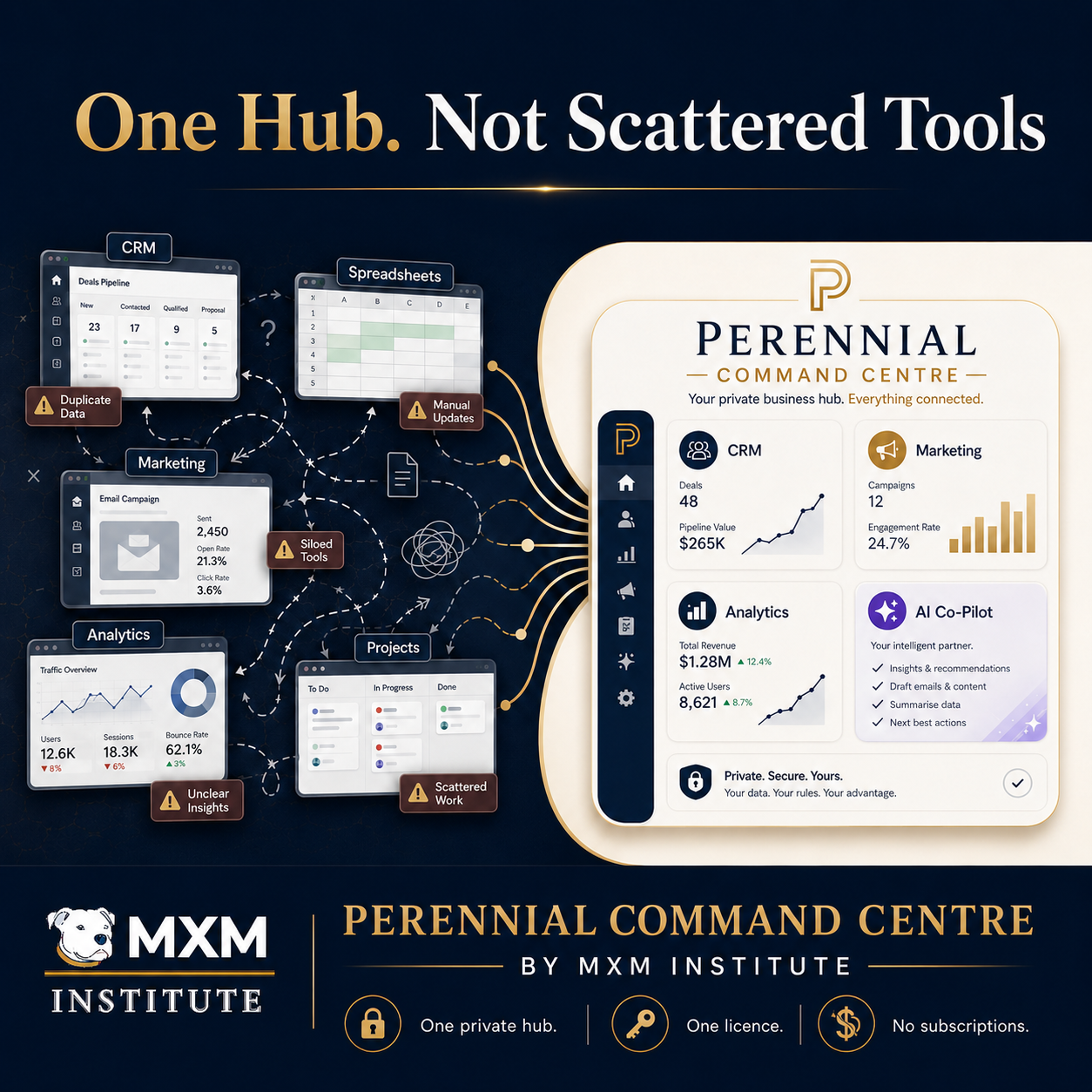
Most small business owners we speak to are not short on software. They have a CRM, a spreadsheet for pipeline, a separate tool for marketing, another for analytics, maybe a project board on top of all of it. The problem is not a lack of tools, it is that none of them talk to each other.
Here is what that actually costs, and what running the business as one system looks like instead.
The real cost of scattered tools
Every time information has to be manually moved from one tool to another, that is time spent on admin instead of the business. A lead comes in through one channel, gets logged somewhere else, and the follow-up happens in a third place if it happens at all. Nothing is wrong with any single tool, but the gaps between them are where things get missed.
You lose visibility, not just time
When your CRM, your marketing activity, and your numbers all live in different places, there is no single view of how the business is actually tracking. You end up checking four things to answer one question, or worse, not checking at all and running on instinct.
It does not scale with you
A spreadsheet works fine when it is just you. The moment you bring someone else in, or the business grows past what you can hold in your head, the scattered approach starts to actively slow things down rather than just being mildly annoying.
What one system actually looks like
Perennial Command Centre was built as a single private hub for exactly this: CRM, marketing, and analytics in one place, with an AI Co-Pilot sitting across all of it to help you actually use the data rather than just store it. Not another tool added to the pile, a replacement for the pile.
Perennial Command Centre is a local business operating system for Australian small business, built by MXM Institute. One private hub, one licence, no subscriptions. If your business is being run across too many disconnected tools, it is worth a proper look: mxminstitute.com.au