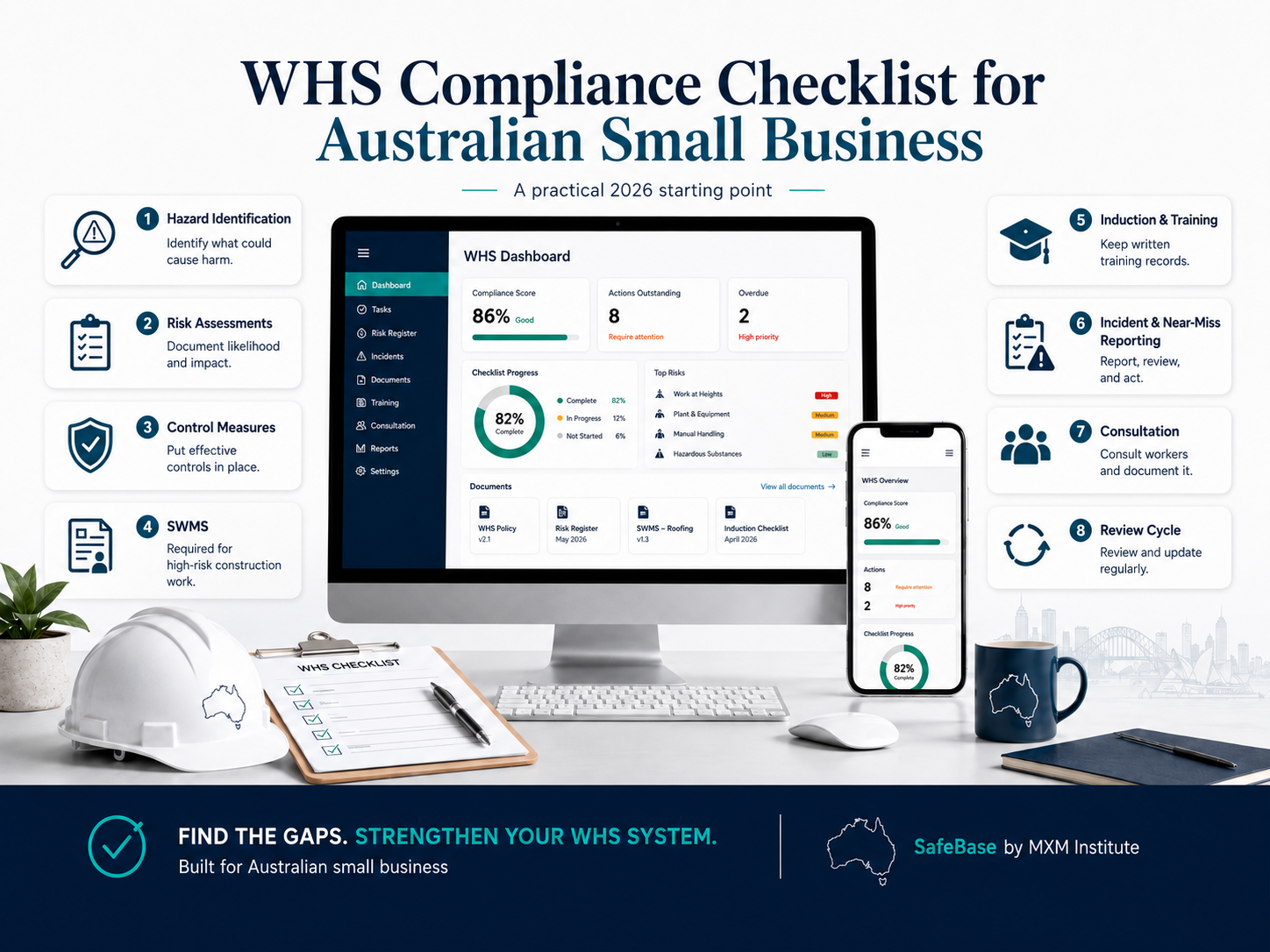
If you run a small business anywhere in Australia, you are legally required to manage work health and safety risks. Most states and territories operate under the harmonised model Work Health and Safety laws; Victoria and WA run their own separate but similarly structured OHS legislation. Whichever applies to you, the obligation does not change because you only have a handful of staff, or none at all. What changes is how much time you have to actually put a system together.
Below is a practical starting checklist. It will not replace a full WHS system, but it will show you exactly where the gaps are.
Prefer to print and tick as you go?
Grab the free PDF version of this exact checklist — same 8 items, ready to print.
1. Hazard identification
Have you actually walked your workplace (or job site) and written down what could hurt someone? Not what you think should be there — what is genuinely present. This includes manual handling, plant and equipment, chemicals, working at heights, driving, and psychosocial hazards like fatigue or bullying.
2. Risk assessments
For each hazard identified, is there a documented assessment of how likely it is and how bad the outcome could be? Verbal awareness is not a risk assessment. If your business were audited tomorrow, could you produce something in writing?
3. Control measures
For every risk assessed, is there a control measure in place, and is it actually being used? The hierarchy of controls matters here — elimination and substitution first, PPE last, not first.
4. Safe Work Method Statements (SWMS)
If your business does any high-risk construction work, SWMS are a legal requirement in every Australian state and territory, not a nice-to-have. Do you have current, signed SWMS for every high-risk activity your team performs?
5. Induction and training records
Can you prove, in writing, that every worker (including subcontractors) has been inducted and trained for the specific risks of their role? "I told them when they started" does not hold up if something goes wrong.
6. Incident and near-miss reporting
Is there an actual process for workers to report incidents and near misses, and are those reports being reviewed and acted on? A system nobody uses is not a system.
7. Consultation
Are workers actually being consulted on WHS matters that affect them, and is that consultation documented? This is a specific legal requirement under the Act, not just good practice.
8. Review cycle
When was your WHS documentation last reviewed? If you cannot remember, that is the answer.
Where most small businesses actually sit
Most small business owners we speak to have some of this in their head, a bit of it on paper somewhere, and none of it in a form that would hold up under real scrutiny. That is not a criticism — building a full WHS system from scratch alongside running the business is a genuinely large task, and it is easy to keep pushing it down the list until something forces the issue.
If you got through this checklist and found more gaps than ticks, that is worth taking seriously — not because of the paperwork, but because of what the paperwork is actually there to prevent.
MXM Institute built SafeBase, a complete Australian WHS system, for exactly this reason — 16 documents, a digital portal, a safety dashboard, and AI prompts throughout, so the system is actually usable rather than sitting in a drawer, wherever in Australia you operate. If you want to see what a proper WHS system looks like, it is worth a look: mxminstitute.com.au