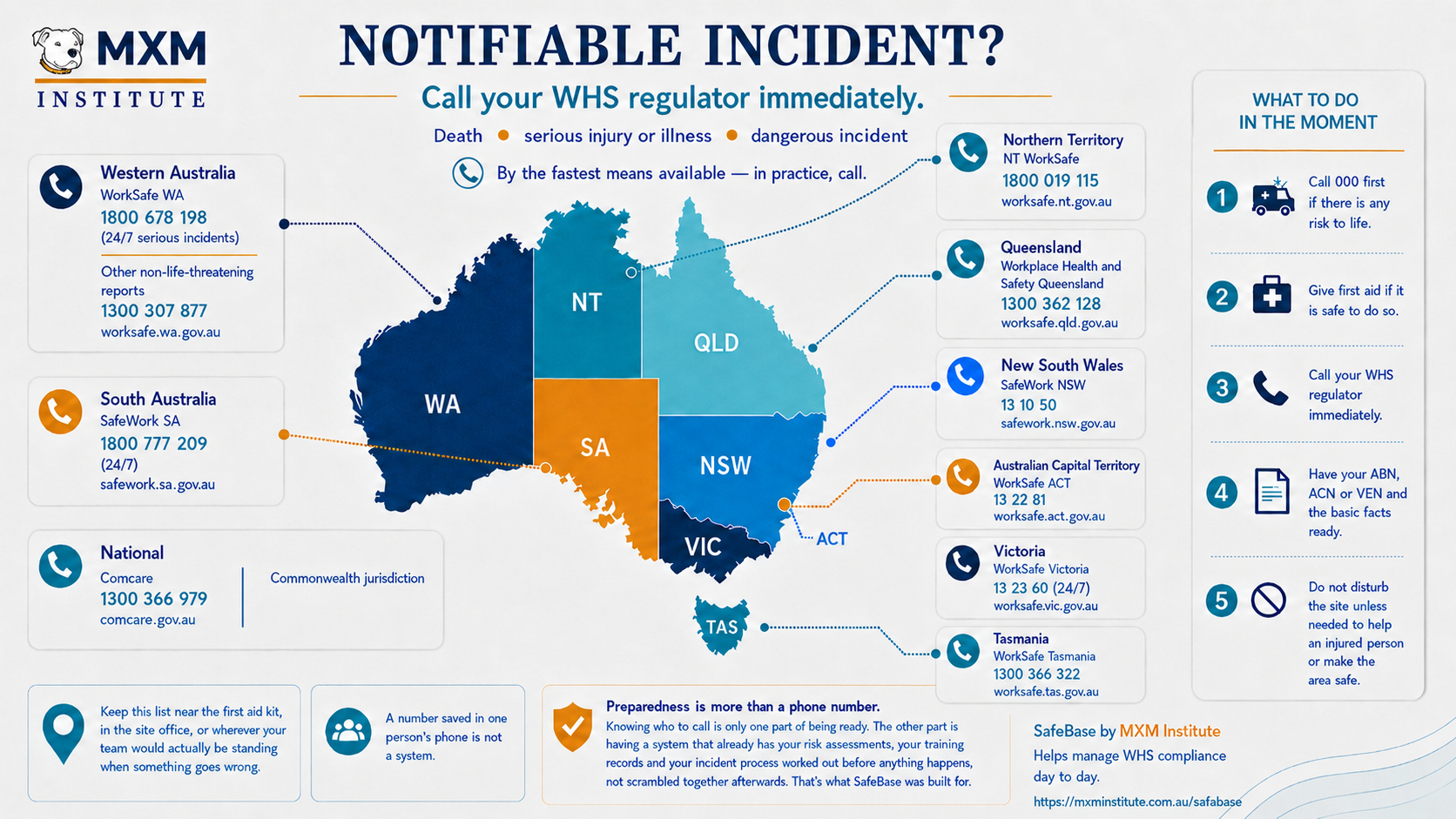
If a death, a serious injury or illness, or a dangerous incident happens at your workplace, the law requires you to notify your WHS regulator immediately after you become aware of it. Not once the site is secured and the paperwork is started. Not after you have spoken to your insurer. Immediately, by the fastest means available, which in practice almost always means a phone call.
The problem is that "your WHS regulator" is a different organisation with a different phone number depending on which state or territory you are in, and an active incident is the worst possible moment to be searching for the right one.
Below is the current notifiable incident line for every jurisdiction, checked directly against each regulator's own site.
National
Comcare (Commonwealth jurisdiction) — 1300 366 979 — comcare.gov.au
New South Wales
SafeWork NSW — 13 10 50 — safework.nsw.gov.au
Queensland
Workplace Health and Safety Queensland — 1300 362 128 — worksafe.qld.gov.au
Victoria
WorkSafe Victoria — 13 23 60, available 24 hours a day, 7 days a week — worksafe.vic.gov.au
Western Australia
WorkSafe WA — 1800 678 198 (24 hours) for a death, serious injury or illness, or a life-threatening dangerous incident. For other non-life-threatening reports, 1300 307 877 — worksafe.wa.gov.au
South Australia
SafeWork SA — 1800 777 209, available 24 hours a day, 7 days a week — safework.sa.gov.au
Tasmania
WorkSafe Tasmania — 1300 366 322 — worksafe.tas.gov.au
Australian Capital Territory
WorkSafe ACT — 13 22 81 — worksafe.act.gov.au
Northern Territory
NT WorkSafe — 1800 019 115 — worksafe.nt.gov.au
What to do in the moment
Regardless of which state you are in, the sequence is the same. Call 000 first if there is any risk to life. Give first aid if it is safe to do so. Then call your WHS regulator using the number above, and be ready to give your ABN, ACN or WEN and the basic facts of what happened. Do not disturb the site until an inspector arrives or directs otherwise, unless doing so is necessary to help an injured person or make the area safe.
Keep this somewhere your team can actually find it
A number saved in one person's phone is not a system. Print this list and keep a copy near the first aid kit, in the site office, or wherever your team would actually be standing when something goes wrong. The businesses that handle a serious incident well are rarely the ones with the most paperwork. They are the ones where whoever is on site that day already knows exactly who to call.
Where MXM Institute fits in
Knowing who to call is only one part of being ready. The other part is having a system that already has your risk assessments, your training records and your incident process worked out before anything happens, not scrambled together afterwards. That is what SafeBase was built for. mxminstitute.com.au