An inspector turning up unannounced is something most business owners hope never happens. It's also something many have never thought through. Who deals with them? What can they actually do? What do you have to do?
This guide explains how inspectors and the regulator work under the model Work Health and Safety (WHS) laws. It uses Queensland's Act as the worked example. The model laws apply in most states and territories, but Victoria has its own Occupational Health and Safety Act 2004, which is different. If you operate in Victoria, check with WorkSafe Victoria.
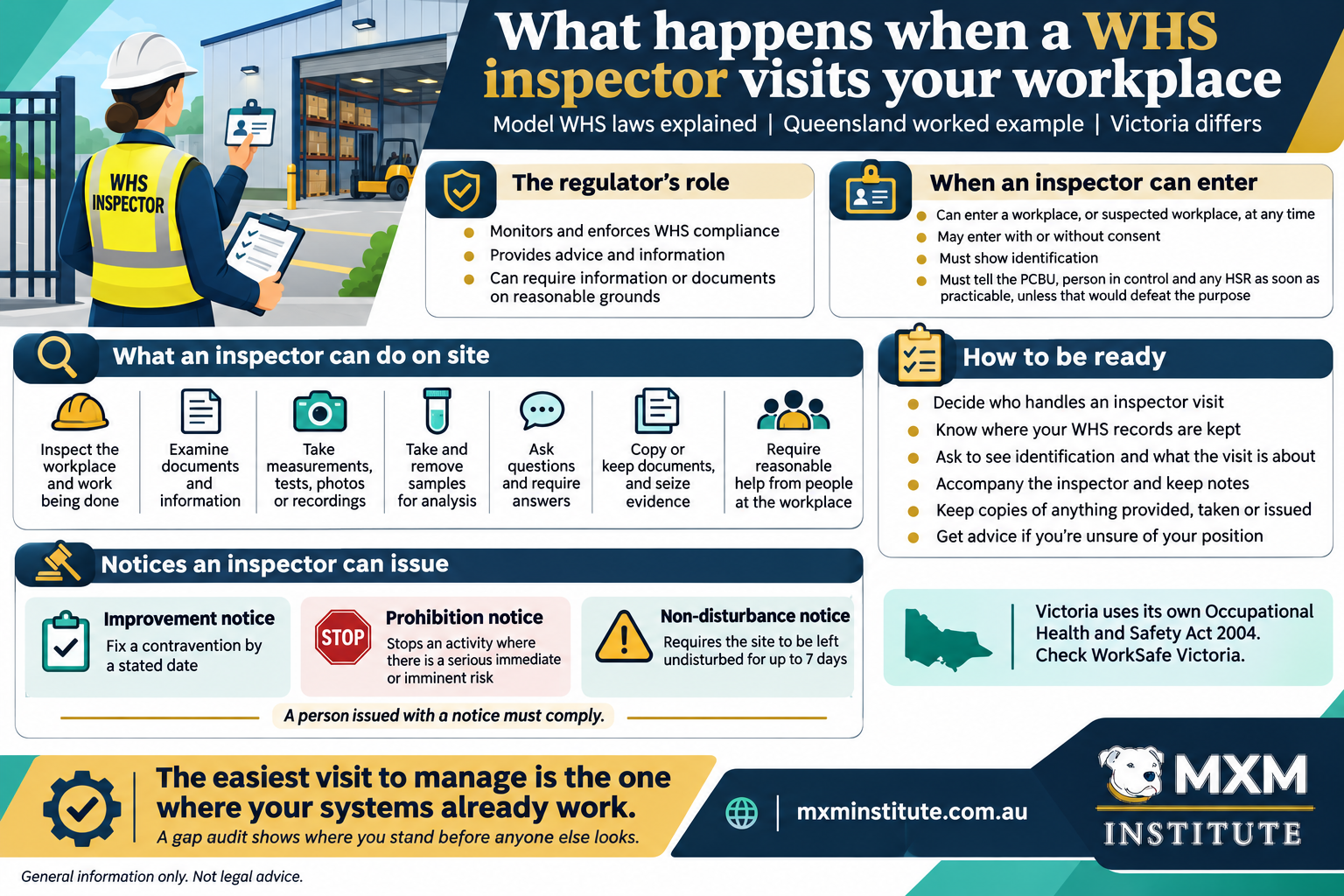
THE REGULATOR'S ROLE
The regulator is the government body responsible for WHS in each jurisdiction. In Queensland that's Workplace Health and Safety Queensland (WorkSafe Queensland). Its functions include monitoring and enforcing compliance with the Act, and providing advice and information to the people who have duties under it.
The regulator can also require a person to give it information or documents where it has reasonable grounds to believe that person is able to provide them.
Inspectors are appointed by the regulator. Their role isn't only enforcement. Their functions include giving advice, helping resolve safety issues, and investigating possible contraventions.
WHEN AN INSPECTOR CAN ENTER
An inspector can enter a workplace, or a place they suspect is a workplace, at any time, with or without the consent of the business.
When they arrive, they must show their identification. They must also tell the person conducting the business or undertaking (PCBU), the person in control of the workplace, and any health and safety representative, as soon as practicable. The exception is where telling them would defeat the purpose of the entry.
WHAT AN INSPECTOR CAN DO ONCE INSIDE
Once on site, an inspector can:
- inspect and examine the workplace and the work being done
- use equipment, take measurements and conduct tests
- make recordings
- take and remove samples for analysis
- require access to documents and information, and require answers to their questions
- copy and keep documents, and seize evidence
People at the workplace must give reasonable help when asked.
The Act also provides for search warrants. A magistrate can issue one where there are reasonable grounds to believe evidence of an offence exists, or may exist within 72 hours. Generally the inspector must announce the warrant and allow entry before executing it, unless immediate entry is needed for safety or to avoid frustrating the warrant.
THE NOTICES AN INSPECTOR CAN ISSUE
Three types of notice are available:
1. Improvement notice
Issued where an inspector reasonably believes a contravention will continue or be repeated. It identifies the provisions involved, gives reasons, and sets a reasonable date by which the problem must be fixed.
2. Prohibition notice
Issued where an inspector reasonably believes an activity involves a serious risk to health or safety from immediate or imminent exposure to a hazard. It prohibits the activity, or requires it to be done in a particular way, until the inspector is satisfied the risk has been dealt with.
3. Non-disturbance notice
Issued where it's necessary for the inspector to exercise their powers. It can require the site to be left undisturbed for up to seven days.
A person issued with one of these notices must comply. Failing to comply is an offence.
HOW TO BE READY
The following are practical suggestions, not legal advice.
- Decide in advance who in your business deals with an inspector, and who steps in when that person is away.
- Know where your WHS records are, and make sure the person who deals with a visit can find them: risk assessments, training and induction records, consultation records, incident reports and procedures.
- On the day, ask to see identification and ask what the visit is about.
- Have someone accompany the inspector, and make notes of what is asked for and what is said.
- Give reasonable help, and keep copies of anything provided, taken or issued, including any notice.
- If you're unsure about your obligations or your position, get advice before you respond.
The easiest visit to manage is the one where your systems already work. A gap audit shows where you stand before anyone else looks.
What happens when a WHS inspector visits your workplace
Frequently Asked Questions
Yes. Under the model laws an inspector can enter a workplace at any time, with or without consent. They must show identification and tell the people in charge as soon as practicable, unless that would defeat the purpose of the entry.
The Act allows inspectors to require information, documents and answers, and people must give reasonable help when asked. The Act also contains protections, including around self-incrimination. If you're unsure of your position, get advice.
Yes. Inspectors can copy and keep documents, take and remove samples for analysis, and seize evidence.
An improvement notice requires a problem to be fixed by a set date. A prohibition notice stops an activity because there is a serious risk from immediate or imminent exposure to a hazard, and stays in place until the inspector is satisfied the risk has been dealt with.
No. Victoria has its own Occupational Health and Safety Act 2004, and its provisions differ from the model laws. Check with WorkSafe Victoria.