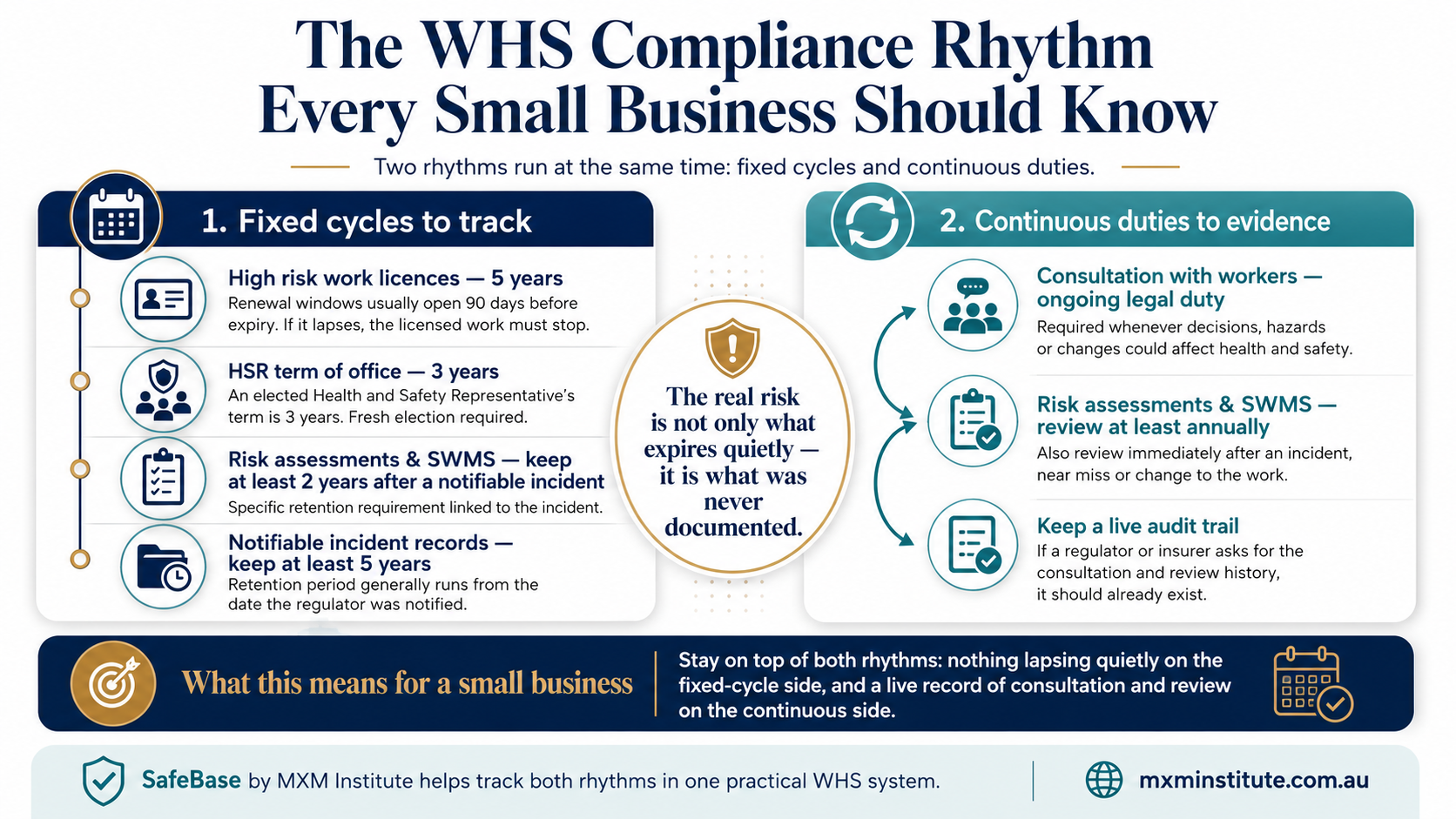
WHS compliance does not run on one fixed date every business needs to circle on the calendar. What it has instead are two different rhythms, running at the same time, each easy to lose track of in its own way.
One rhythm is fixed. Licences, terms and retention periods each run on their own cycle, quietly, in the background, until one of them lapses and suddenly becomes urgent. The other rhythm is not a date at all. It is a habit of consultation and review that either happens or does not, and only shows up as a gap when someone asks to see it.
Most small businesses do not miss these because they are careless. They miss them because nobody in the business owns tracking either cycle. Here is what is actually on them.
High risk work licences: a 5 year cycle
If anyone in your business holds a high risk work licence, for work like operating a crane, forklift, scaffolding, rigging or dogging, that licence is valid for 5 years from the date it was issued. This is consistent across every state and territory. Renewal windows typically open in the 90 days before expiry, and in most jurisdictions you have up to 12 months after expiry to renew before the holder has to redo training and assessment from scratch. Once a licence lapses, the licensed work legally has to stop, whether or not anyone in the business has noticed yet.
Health and Safety Representatives: a 3 year term
If your business has an elected Health and Safety Representative, their term of office runs for 3 years. It is not automatically renewed. If the term lapses without a fresh election, the business is left without an active HSR, often without anyone realising until the gap is pointed out, usually during an audit or after an incident.
Risk assessments and SWMS: at least 2 years after an incident
Under the model WHS laws, if a notifiable incident occurs, the risk assessment, WHS management plan or Safe Work Method Statement connected to that work must be kept for at least 2 years after the incident occurred. This is a specific legal retention period, not a general filing preference.
Notifiable incident records: a minimum of 5 years
Where a jurisdiction specifies a retention period, notifiable incident records generally need to be kept for at least 5 years from the date the notification was made to the regulator, not from whenever the file was eventually closed internally.
A note on Victoria
The specific timeframes above come from the model WHS laws, which apply in every state and territory except Victoria. Victoria operates under its own Occupational Health and Safety Act 2004, administered by WorkSafe Victoria. The general shape of these obligations, licensing, HSR-style representation, incident record-keeping, is broadly similar, but the specific rules and timeframes can differ. If you're a Victorian business, check the exact requirement with WorkSafe Victoria rather than assuming the figures above apply directly.
Some of it isn't a date at all — it's a habit
Not every WHS obligation has an expiry date attached. Consultation with your workers on health and safety matters isn't a once-a-year checkbox, it's a standing legal duty under the WHS Act, required whenever a decision, hazard or change to the work could affect them. There's no renewal notice for this one. It's either happening, or it isn't.
The same goes for risk assessments and Safe Work Method Statements once they're in place. They're not set-and-forget documents. The accepted standard is to review them at least annually for ongoing risks, and immediately after any incident, near-miss, or change to how the work is done.
This is where most small businesses actually fall down. Not on the licence that expired, but on the fact that when a regulator or insurer asks to see the consultation and review history behind a piece of work, there isn't one to show. A missed licence renewal is a paperwork gap. A missing audit trail is the difference between demonstrating you met your duty and not being able to prove it at all.
Why none of this shows up on one calendar
Some obligations are fixed and scattered across licences, elections and record-keeping rules that only apply if your business happens to have that particular thing. Others are continuous and never show up as a date at all, they only show up as a gap when someone goes looking for evidence that was never recorded. Nobody hands you a single list covering both.
What this actually means for a small business
The businesses that stay on top of WHS are not the ones with the most paperwork. They are the ones running both rhythms at once, nothing lapsing quietly on the fixed-cycle side, licences, HSR terms, retention periods, and a live, ongoing trail of consultation and review building up on the continuous side, so if anyone ever asks to see it, it already exists.
Where MXM Institute fits in
This is exactly the gap a proper WHS system is meant to close, tracking both rhythms against your actual licences, your actual HSR, and your actual consultation and review activity, so nothing lapses quietly and nothing goes undocumented. That is what SafeBase was built for. mxminstitute.com.au