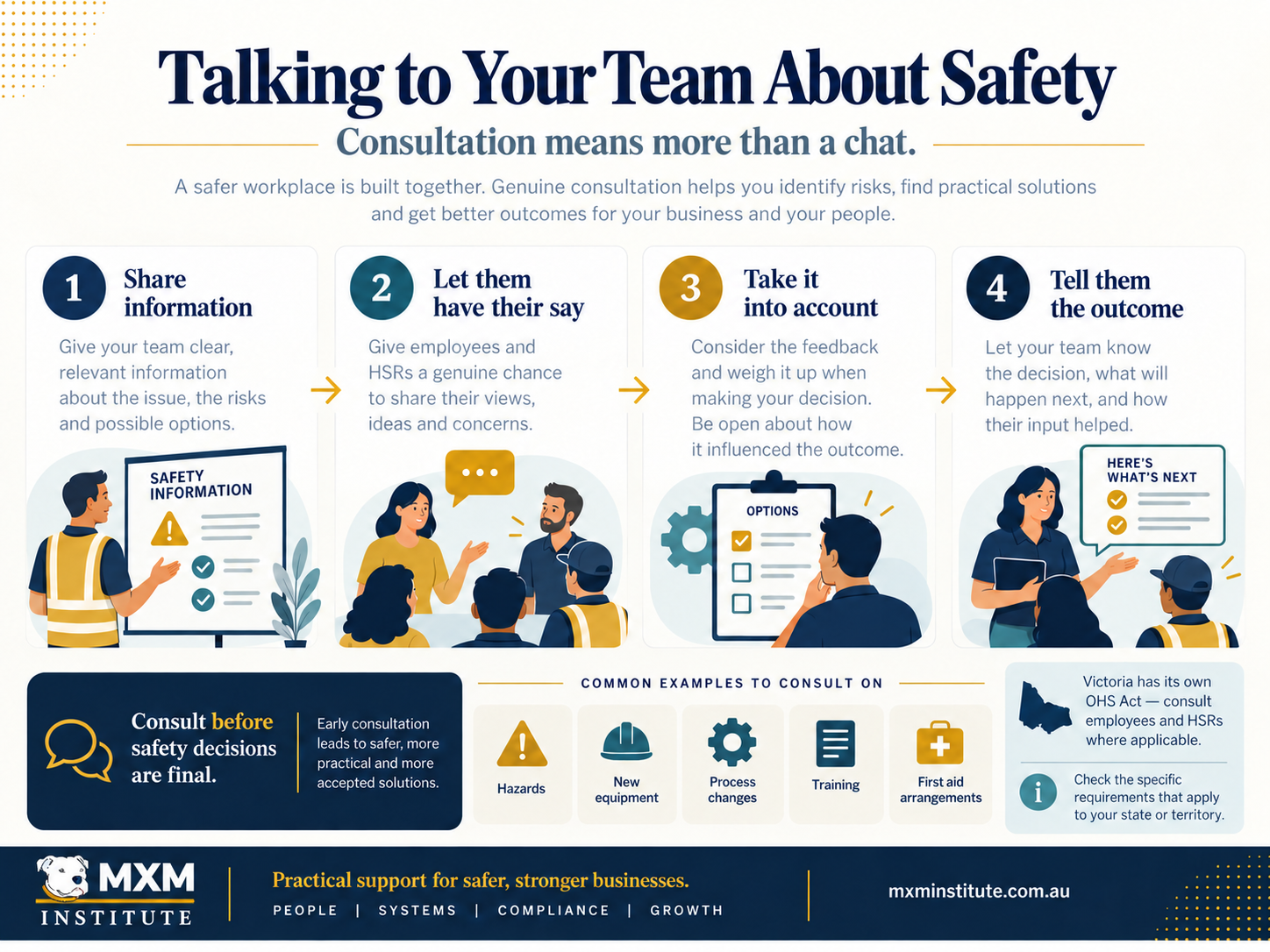
Most business owners talk to their team about safety. But if an inspector, an insurer or a worker asked how you consult on safety decisions, could you show them?
Consultation is a legal duty, and it is easy to get wrong because it usually happens informally, in passing, with nothing written down.
What the duty is
If a safety decision could affect your workers, you need to involve them before you make it. In most of Australia, this is required under the model WHS laws, and it is limited to what is reasonable for your business and situation.
Workers means anyone who does work for your business: employees, contractors, labour hire workers, apprentices and volunteers.
What good consultation looks like
There are four parts:
Share the information. Give people what they need to understand the issue.
Let them have their say. Ask for their views and give them a genuine chance to raise concerns and ideas.
Take it into account. Their input should actually shape the decision.
Tell them the outcome. Let them know what was decided, and do it in good time.
A suggestion box on its own does not meet this. Neither does announcing a decision that has already been made. The test is whether people had a real chance to contribute before the decision was final.
When you need to consult
Any time a safety matter comes up that affects your people. That includes:
identifying hazards and assessing risks
deciding how to remove or reduce a risk
changes that could affect health or safety, such as new equipment, a new process or a new site
deciding on facilities like amenities and first aid arrangements
setting up or changing your safety procedures, training or consultation arrangements
This is not a once-a-year exercise. It is part of running the business.
Ways to consult
There is no required format. What works depends on the size and type of your business, and most businesses use a mix. Common methods include:
Toolbox talks and pre-start meetings. Short, regular and practical. Good for raising a hazard, explaining a change and hearing concerns on the spot.
Team meetings. Make safety a standing item so it is discussed every time, not only after an incident.
One-on-one conversations. Best when an issue affects a particular person or role, or when someone is not comfortable speaking up in a group.
Surveys and feedback forms. Useful for gathering views from a larger or spread-out team, or on topics people may prefer to answer anonymously. Use them alongside face-to-face discussion, not instead of it.
Workplace walk-throughs. Walk the site with the people who do the work and ask what they see. They often spot hazards that are invisible from the office.
Involving workers in risk assessments and procedures. When you assess a risk, write a safe work procedure or change how a job is done, get the people who do the job in the room.
Everyday feedback channels. A dedicated email address, a messaging group, an app or a feedback board gives people an easy way to raise issues between meetings.
Whichever methods you choose, the pattern is the same: information goes out, people respond, their views are considered and they hear the result. For teams that work shifts, in different locations or across multiple sites, use more than one method so nobody misses out.
What about safety representatives and committees?
You do not need a health and safety representative or committee by default. They come into play when workers ask for one. If your business has a representative, they need to be involved in consultation. And a committee does not replace day-to-day consultation, because you still need to consult whenever a matter comes up, not just when the next meeting is.
Keeping Records of Consultation
Consultation is only as good as your ability to show it happened. Keep a simple record every time you consult: what was discussed, who was there, what views were raised and what was decided.
It does not need to be complicated. A few lines in a notebook, a saved meeting note or a completed form is enough. Safe Work Australia recommends keeping consultation records as good practice, and it is one of the simplest things you can do to protect your business.
If a regulator, an insurer or a worker ever asks how you reached a decision, a record gives you a clear answer. It also shows your team that their input is taken seriously, and it helps you spot patterns over time, such as the same issue coming up again and again.
A note for Victoria
Victoria has not adopted the model WHS laws. It has its own Occupational Health and Safety Act 2004, and the duty to consult is in section 35. The Victorian Act uses the words employer and employee, and the main points are similar:
You must consult employees, and independent contractors you engage, on safety matters that affect them, so far as is reasonably practicable.
If your employees have an elected health and safety representative, that person must be involved in the consultation.
Consultation does not have to end in agreement, but you must genuinely consult before deciding.
Victoria has its own rules on representatives and work groups, so Victorian businesses should check the Victorian Act and WorkSafe Victoria guidance.
This article is general information and is not legal advice.
How MXM Institute can help
Consultation is one of the areas we review in a WHS Gap Audit and Report, which gives you risk-rated findings and a prioritised action plan for your state or territory. If you already have WHS documents, our WHS Document and Policy Review checks them against current legislation and simplifies what is not working. And our WHS System Implementation, using SafeBase, sets up your policies, registers, training records and consultation records so consultation is documented as part of normal operations.
Every engagement is quoted at a fixed fee before any work starts. To request a free quote, visit mxminstitute.com.au/whs-consulting or call 1300 211 087.