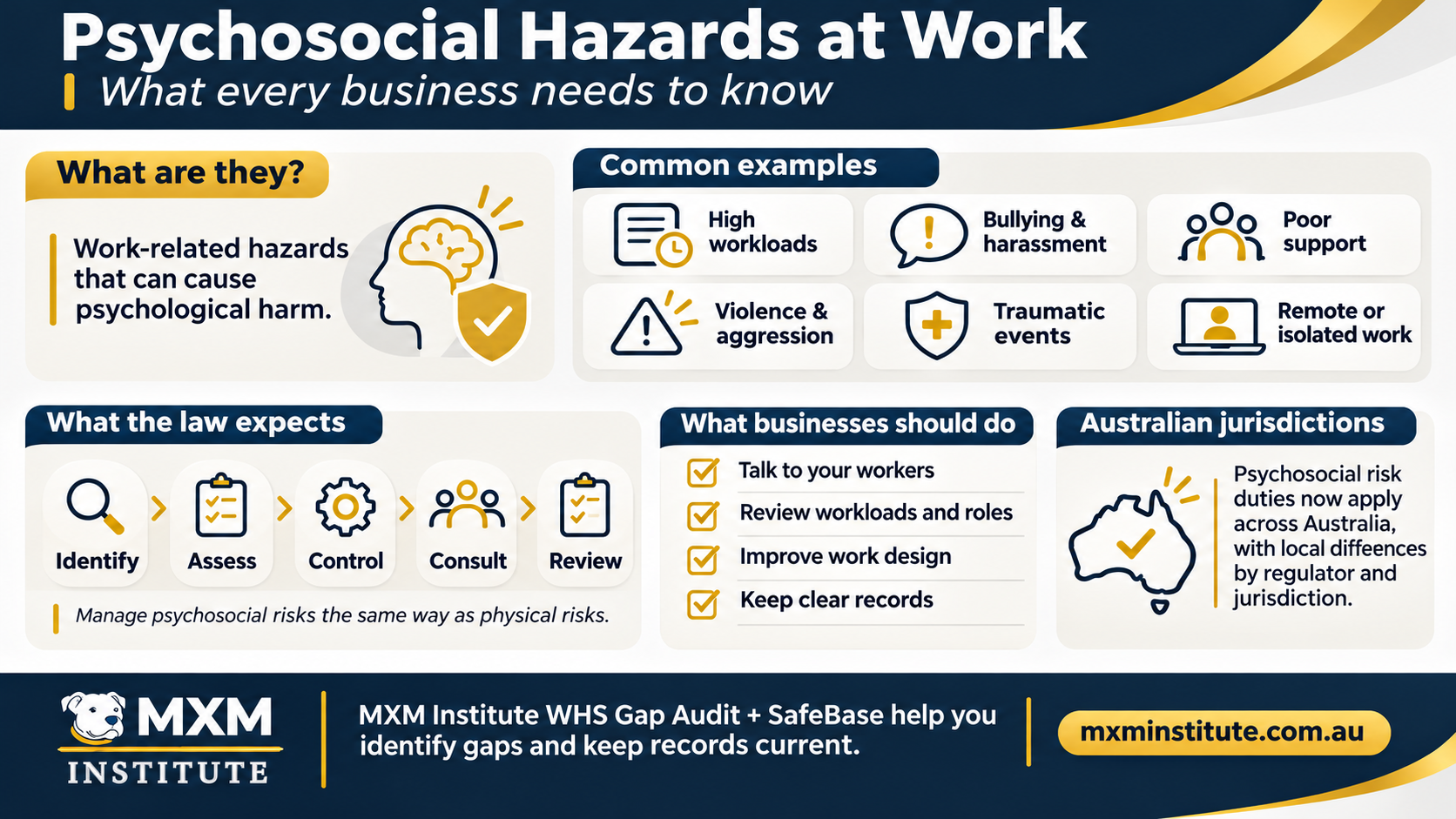
When most people think about workplace safety, they picture the hazards they can see: a wet floor, an unguarded machine, a ladder. But work can also harm people in ways that are harder to spot. Unreasonable workloads, bullying, poor support and exposure to traumatic events can all cause psychological harm, and sometimes physical harm too.
These are called psychosocial hazards, and they are now written into work health and safety law across Australia. This applies to every business that has workers, whatever its size.
What is a psychosocial hazard?
A psychosocial hazard is a hazard that arises from, or relates to, the design or management of work, the work environment, plant at a workplace, or workplace interactions and behaviours, and that may cause psychological harm. The related risk is the risk to a worker's health or safety that comes from that hazard.
Common examples include high job demands, low job control, poor support, bullying, harassment, violence and aggression, exposure to traumatic events, and remote or isolated work.
What does the law expect?
Under the model WHS laws, a business must eliminate psychosocial risks so far as is reasonably practicable. If that is not reasonably practicable, it must minimise them so far as is reasonably practicable. In other words, psychological health is managed the same way as physical health: identify the hazard, assess the risk, put controls in place, and review them.
Workers are also entitled to be consulted on these matters, and a worker includes employees, contractors, labour hire workers, apprentices and volunteers.
Where does this apply?
The model regulations and code of practice written by Safe Work Australia do not apply on their own. Each state, territory and the Commonwealth has to put them into its own law, and each has done so, with different start dates and some local differences.
In the jurisdictions we have checked against the regulators' own pages:
• New South Wales: psychosocial clauses were added to the Work Health and Safety Regulation from 1 October 2022.
• Western Australia: regulations commenced on 24 December 2022.
• Tasmania: the Work Health and Safety Regulations 2022 made managing psychosocial hazards mandatory from December 2022.
• Queensland: the psychosocial risks regulation amended the Work Health and Safety Regulation 2011, commencing on 1 April 2023.
• Commonwealth (Comcare): regulations changed in April 2023.
• Northern Territory: regulations in effect from 1 July 2023.
• South Australia: regulations in effect from 25 December 2023.
• Australian Capital Territory: the psychosocial code of practice commenced on 27 November 2023, supporting new psychosocial regulations.
• Victoria: Victoria runs its own Occupational Health and Safety Act 2004, and its Occupational Health and Safety (Psychological Health) Regulations 2025 commenced on 1 December 2025.
Because details differ, check your own regulator's requirements and code of practice.
What can a business do?
You do not need a new system to start. The same risk management approach you already use for physical hazards applies here.
1. Look for the hazards. Talk to your people. Look at workloads, rosters, how conflict is handled, and where staff work alone or deal with difficult customers.
2. Assess the risk. Consider how likely it is that harm could occur and how serious it could be.
3. Put controls in place. Start with changing the work itself, such as adjusting workloads or fixing unclear roles, before relying on support services or training alone.
4. Consult your workers. They often know where the pressure points are.
5. Review. Check the controls are working and revisit them when the work changes.
Keep a record
A written record of what you looked at, what you decided and what you changed is the best way to show you took the duty seriously.
Where MXM Institute fits in
A WHS Gap Audit gives you an independent view of where your workplace stands against the legislation in your state or territory, with a risk-rated report and a prioritised action plan. SafeBase then gives you the registers and records to keep it going.
mxminstitute.com.au