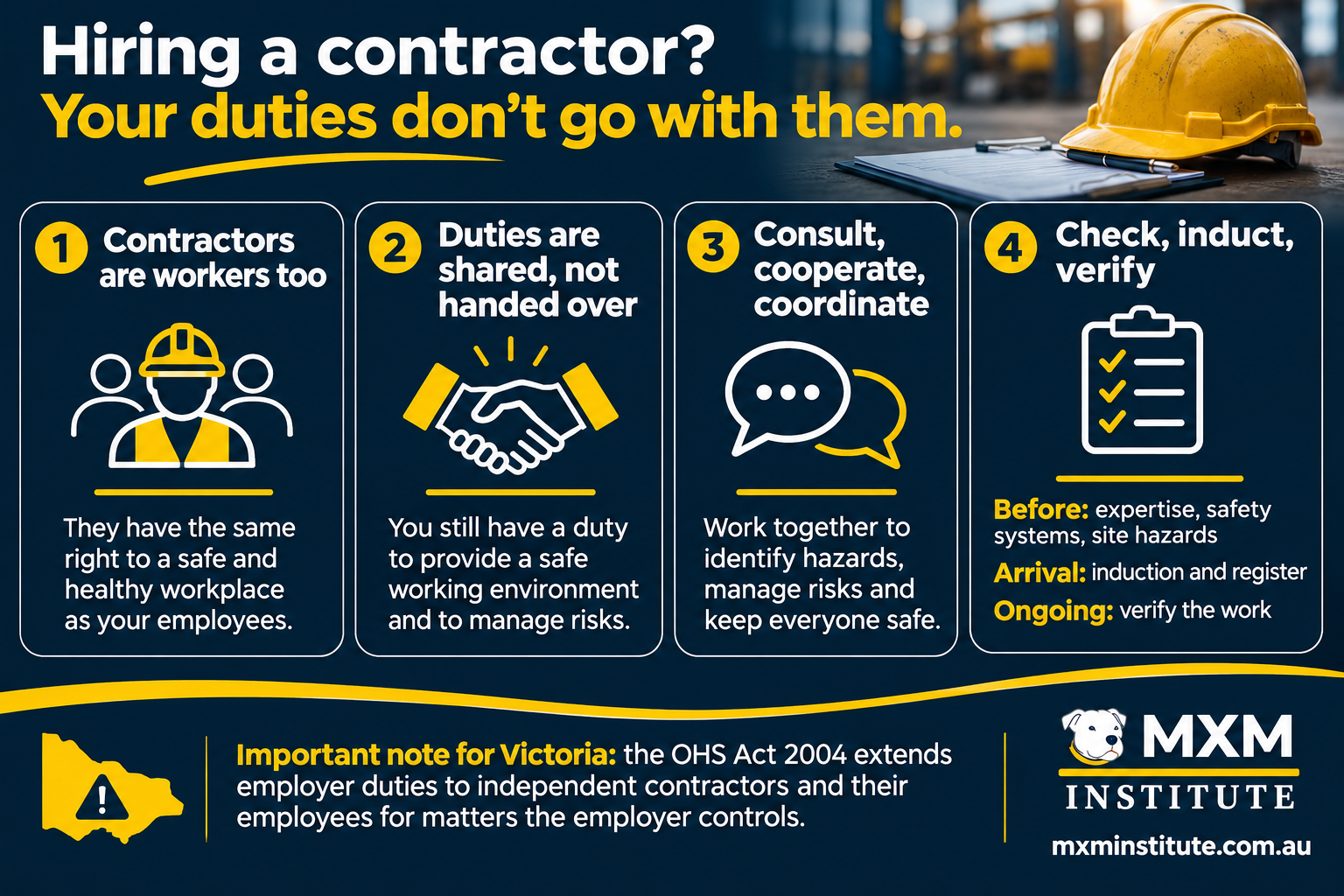
Ask a business owner who is responsible for safety when a contractor is on site and you will often hear "the contractor, that's why we hired them". It is a reasonable instinct, and it is not how WHS law works. Engaging a contractor changes who does the work. It does not change who has duties.
Contractors are workers too
Under the model WHS laws, a worker is anyone who carries out work in any capacity for your business, including employees, contractors, subcontractors, apprentices and trainees. A PCBU's primary duty of care covers workers it engages directly and workers it engages through others, so far as is reasonably practicable. That includes the workers of subcontractors in a contracting chain.
Individual contractors and self-employed people can be both at once: a PCBU in their own right, and a worker for the business that engaged them.
Duties are shared, not handed over
A PCBU cannot contract out its WHS duties. Engaging a contractor does not transfer them. Instead, more than one PCBU can hold the same duty at the same time, and each must do what is reasonably practicable within its own influence and control.
The more control you have over how, when and where the work is done, the more you are expected to do. Relying on a contractor's expertise is reasonable, particularly for specialist work, but it does not mean you have complied. You still need to check that they are doing what they said they would.
Consult, cooperate and coordinate
When businesses share a duty, the model laws require each of them to consult, cooperate and coordinate activities with the others, so far as is reasonably practicable. In practice:
- Consulting means working out together which hazards exist, how your activities affect each other, who could be affected, and who is best placed to manage each risk
- Cooperating means doing what was agreed, not undermining anyone else's safety measures, and responding to reasonable requests for help
- Coordinating means making sure your controls fit together so nothing falls into a gap, including timing the work so people are not exposed to each other's hazards
Start early, ideally before the contractor begins. What is reasonably practicable depends on the situation. Two contractors working side by side may only need regular conversations. A large shopping centre with many tenants needs written agreements and formal arrangements.
You can agree who does what in writing. That is sensible, but an agreement cannot reduce or change your own obligations.
What this looks like when you engage a contractor
Before they start:
- Check they have the right expertise for the job, including licences, qualifications and relevant experience
- Ask about their own safety systems, and confirm they are adequate. Familiarity is not a check
- Define the scope of work, and tell them about hazards specific to your site, such as chemicals, asbestos or restricted areas
When they arrive:
- Run an induction that covers site-specific risks
- Keep a register of who is on site and when
- Agree how they will manage any subcontractors they bring
- Agree how incidents will be reported, and who notifies the regulator
While the work is under way:
- Check the work is being done as agreed, through meetings, inspections or other methods you have agreed
- Ask for evidence of training, instruction and supervision
- Include contractors in your consultation, and act on what they raise
The key point is the same as for officers: verify. A contract that says the contractor will work safely is not evidence that they are.
What this looks like in a small business
You do not need a contractor management department. You need records. A register of contractors, evidence you checked licences and safety systems, inductions recorded, hazards you told them about, and a regular point where someone looks at what was agreed and whether it happened. If something goes wrong, those records show the duty was taken seriously.
If you want to see how the duty sits at the top of the business, we cover it in Who Is Responsible for Safety? PCBUs, Officers & What Due Diligence Actually Means. For how consultation works day to day, see Health and Safety Representatives and Committees: Making Consultation Work.
Victoria is different
Victoria has not adopted the model WHS Act. It operates under the Occupational Health and Safety Act 2004. Under section 21, an employer's duties extend to independent contractors it engages, and to their employees, for matters over which the employer has, or would have, control. Since 22 March 2022, host employers owe the same duties to labour hire workers as they do to their direct employees, and labour hire providers and host employers must consult, cooperate and coordinate with each other. If you operate in Victoria, check which provisions apply to your arrangement.
Where MXM Institute fits in
You cannot verify what you cannot see. A WHS Gap Audit gives you an independent view of where your workplace stands against the legislation in your state or territory, with a risk-rated report and a prioritised action plan. SafeBase then gives you the registers, records and review points that show the system is being used, in one place. mxminstitute.com.au