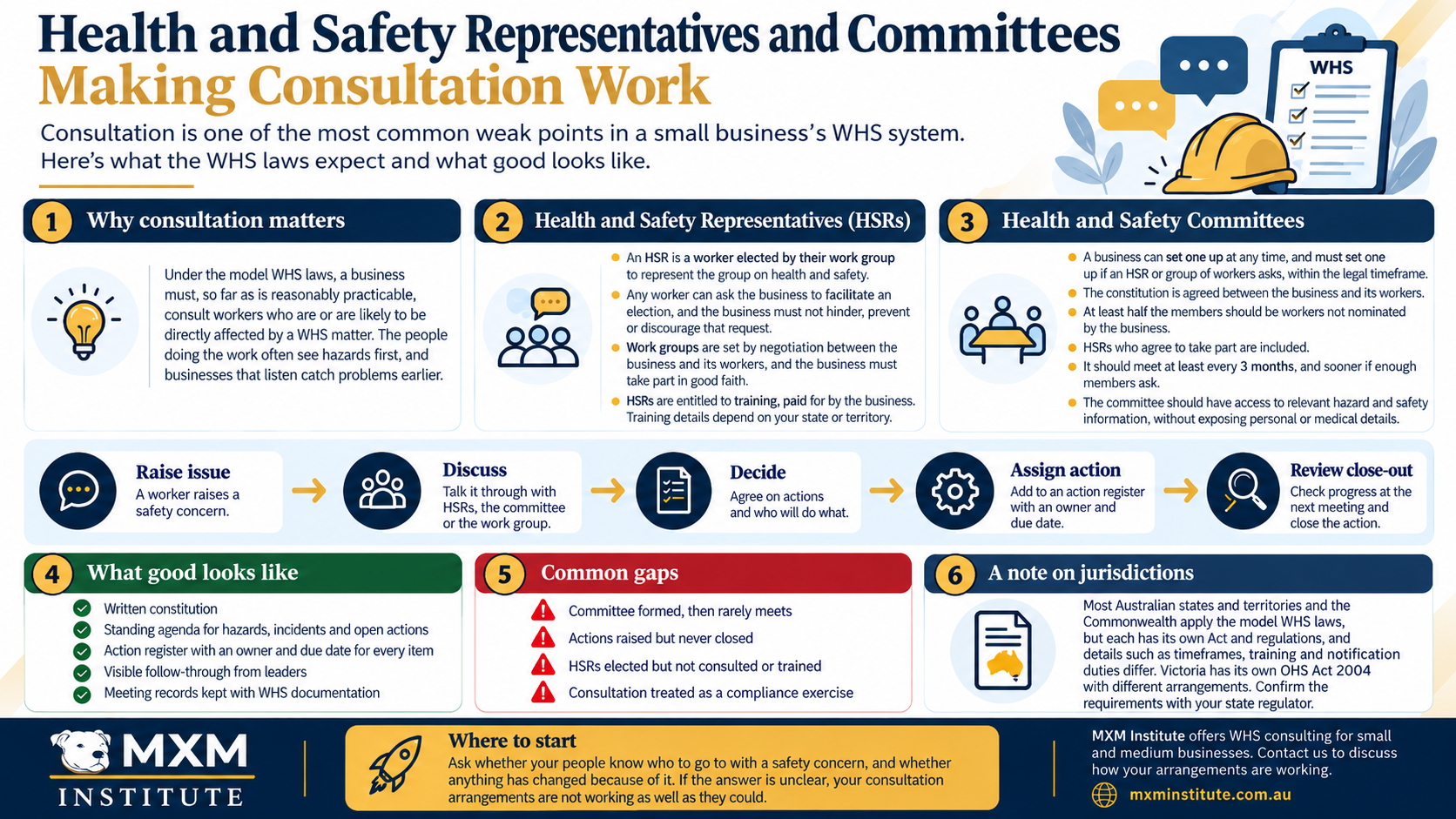
Consultation is one of the most common weak points in a small business's WHS system. Here's what the WHS laws expect and what good looks like.
Why consultation matters Under the model WHS laws, a business must, so far as is reasonably practicable, consult workers who are or are likely to be directly affected by a work health and safety matter. The people doing the work often see the hazards first, and a business that listens catches problems earlier.
Health and Safety Representatives (HSRs) An HSR is a worker elected by their work group to represent the group on health and safety.
Any worker can ask the business to facilitate an election, and the business must not hinder, prevent or discourage that request.
Work groups are set by negotiation between the business and its workers, and the business has to take part in good faith and within a short timeframe.
HSRs are entitled to training, paid for by the business. The content, length and timing are set by your state's regulation, so check the current requirements.
Health and Safety Committees
A business can set one up at any time, and has to set one up if an HSR or a group of workers asks, within a timeframe set by the law in your state.
The constitution is agreed between the business and its workers. At least half the members should be workers who weren't nominated by the business, and HSRs who agree to take part are included.
Functions: to facilitate cooperation between the business and its workers on safety measures, and to help develop the safety standards, rules and procedures followed at the workplace.
It should meet at least every three months, and sooner if enough members ask.
Members should be given time to take part, and the committee should have access to the business's information on workplace hazards and workers' health and safety, without identifying individual workers' personal or medical details.
What good looks like
A written constitution: who's on it, how often it meets, what it covers
A standing agenda covering hazards, incidents and open actions
An action register with an owner and due date for each item, reviewed every meeting
Visible follow-through from leaders
Meeting records kept as part of your WHS documentation
Common gaps
Committee formed, then rarely meets
Actions raised but never closed
HSRs elected but not consulted or trained
Consultation treated as a compliance exercise
A note on jurisdictions Most Australian states and territories and the Commonwealth apply the model WHS laws, but each has its own Act and regulation, and details such as timeframes, training and notification duties differ. Victoria has its own OHS Act 2004 with different arrangements. Confirm the requirements with your state regulator.
Where to start Ask whether your people know who to go to with a safety concern, and whether anything has changed because of it. If the answer is unclear, your consultation arrangements are worth a review.
MXM Institute offers WHS consulting for small and medium businesses. Contact us to discuss how your arrangements are working.