Ask most small business owners the difference between a hazard report and an incident report, and you will get a pause, then a guess. It is an easy pair of terms to blur together, and in a lot of workplaces the two get filed in the same place, treated the same way, or worse, only one of them ever gets used at all.
That confusion is not a paperwork problem. It is the difference between catching a problem before someone gets hurt, and only ever finding out about it after they do.
What a hazard is, and what a hazard report is for
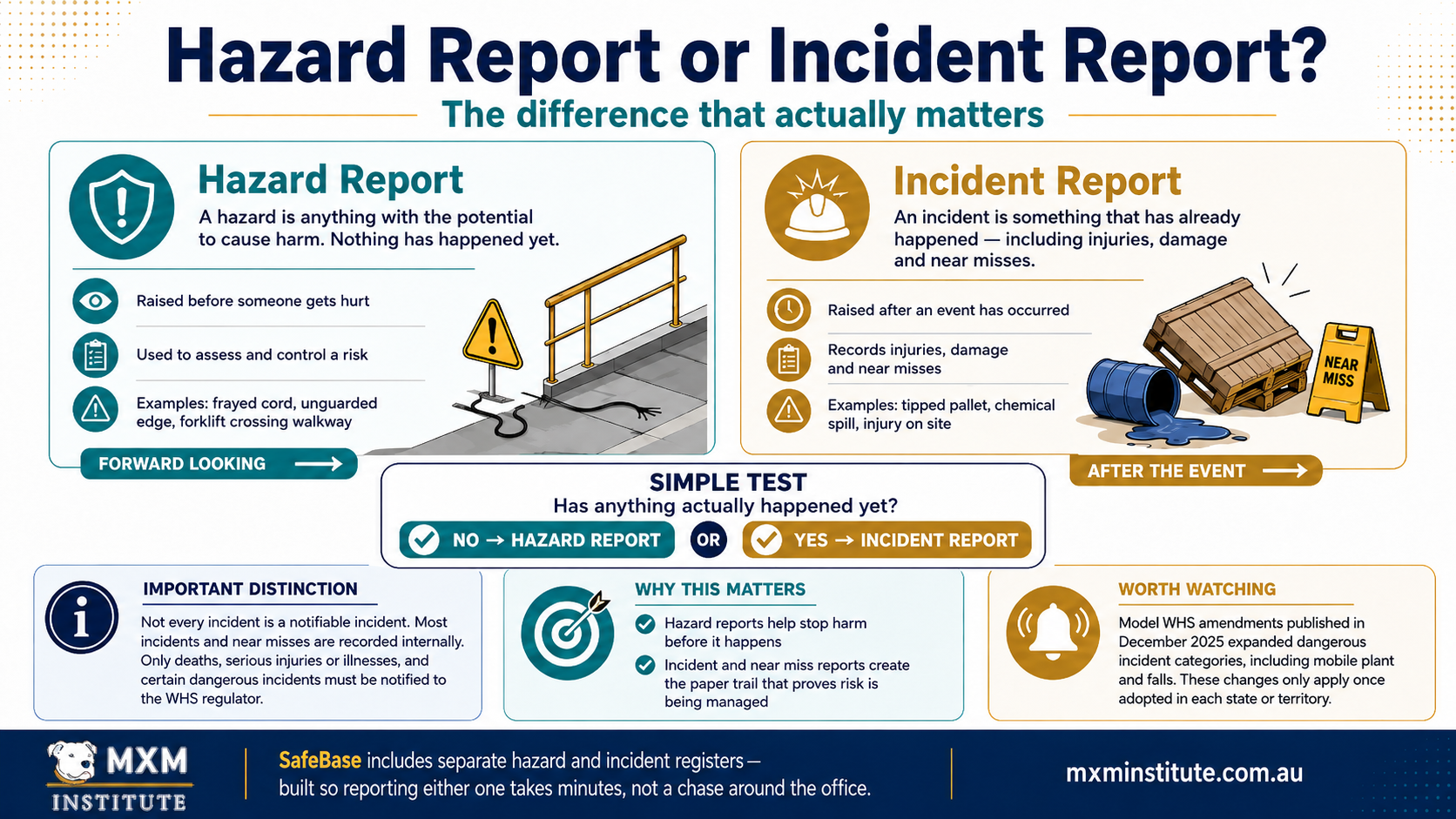
A hazard is anything with the potential to cause harm. A frayed extension cord. An unguarded edge on a mezzanine. A forklift route that crosses a pedestrian walkway. Nothing has happened yet. Nobody has been hurt. The hazard report exists to capture that observation while it is still just a risk, so it can be assessed and controlled before it becomes something worse.
A hazard report is entirely forward looking. Its whole value depends on being raised early, by whoever noticed it, before it turns into an incident.
What an incident is, and what an incident report is for
An incident is something that has already happened. That includes actual injuries and property damage, but it also includes near misses, where nothing went wrong only because of luck or quick reaction, not because the risk was not real. A pallet that tips but does not land on anyone. A chemical spill that is contained before anyone is exposed. Both of those are incidents, and both should be recorded, even though no one was hurt.
This is where most small businesses under-report. Injuries get written up because there is an obvious reason to. Near misses rarely do, because nothing bad technically happened. That is exactly backwards. A near miss is a hazard that has already proven it can hurt someone. It is some of the most valuable safety information a business will ever get, and it is usually the first thing that goes unrecorded.
Not every incident is a notifiable incident
One more distinction worth being clear on: recording an incident internally is not the same as notifying your WHS regulator. A notifiable incident is a specific legal category under the WHS Act, covering a death, a serious injury or illness, or a dangerous incident as defined in the Regulations. Most incidents a business records, including most near misses, do not meet that threshold and are handled internally.
If you do need to know who to call for an actual notifiable incident, we have covered the current phone number for every state and territory regulator in a separate piece: Where to Report a Workplace Incident, State by State.
What this actually costs a business that gets it wrong
A business that only records injuries is flying with half the instruments off. It reacts to harm after it happens, instead of catching the pattern of near misses and hazard reports that usually comes before it. When something does go wrong, that gap shows up again in a different form, as an absence of paper trail. A hazard and incident register that is actually kept up to date is direct evidence that a business is managing risk, not just responding to it. That record matters for due diligence under the WHS Act, and it is exactly the kind of thing an insurer, an administrator, or a liquidator will go looking for when something has gone wrong and they are trying to work out whether the business took its obligations seriously.
A simple way to keep the two separate
The test is not complicated. Ask one question: has anything actually happened yet? If the answer is no, and you are describing a risk or a condition, it is a hazard report. If the answer is yes, even if no one was hurt, it is an incident report. Keeping two clearly separate logs, rather than one blended list, makes it obvious at a glance which risks are still open and which events have already occurred and need a closer look.
A change worth knowing about
In December 2025, Safe Work Australia published amendments to the model WHS Act that extend notification duties to cover additional categories of dangerous incident, including those involving mobile plant and falls. These changes only take effect once adopted into your state or territory's own WHS laws, so they are not automatically in force yet, but they signal where notification requirements are heading. Worth keeping an eye on rather than acting on immediately.
Where MXM Institute fits in
Knowing the difference between a hazard and an incident is the easy part. Building a system where your team actually uses both, consistently, without it becoming another form nobody fills in, is the harder part. SafeBase includes both a hazard register and an incident register as part of its core documentation, built so that reporting either one takes minutes, not a chase around the office for the right form. mxminstitute.com.au