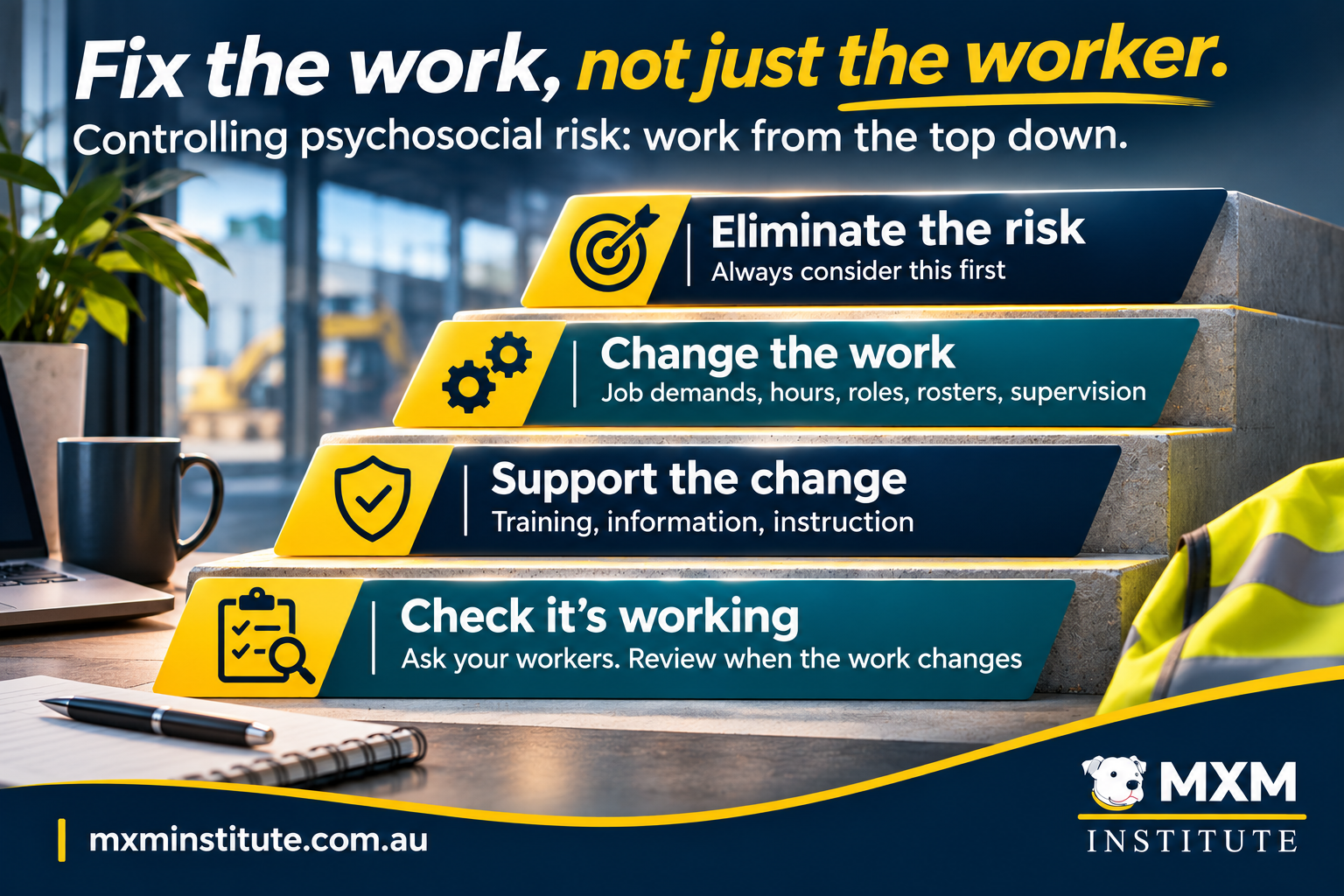
The most common first response to psychosocial risk is to add support: an employee assistance program, a wellbeing email, a resilience session. These help. On their own, though, they leave the hazard where it was.
What the law and guidance say
Under the model WHS laws, a business must eliminate risks if it reasonably can, and otherwise minimise them as far as is reasonably practicable. Safe Work Australia’s guidance sets the order of preference: elimination first, then substitution, isolation and engineering controls, then administrative controls such as training and supervision, and personal protective equipment last. It describes administrative controls and PPE as the least effective because they depend on people behaving correctly and on supervision.
For psychosocial hazards, the regulations say that when choosing control measures you must consider the design of work, including job demands and tasks, and the systems of work, including how work is managed, organised and supported. You must also consider the information, training, instruction and supervision workers are given.
Victoria has its own OHS Act 2004. Its Psychological Health Regulations commenced on 1 December 2025 and say information, instruction and training can’t be the only control where other controls are practicable.
Questions to ask for each hazard
Can we remove it?
If not, what in the work can we change: workload, hours, roles, rosters or supervision?
What support or training backs that change up?
How will we know it’s working?
Ask the workers at each step, and review the controls when the work changes.
MXM Institute runs psychosocial audits for businesses of any size. Find out more at mxminstitute.com.au.