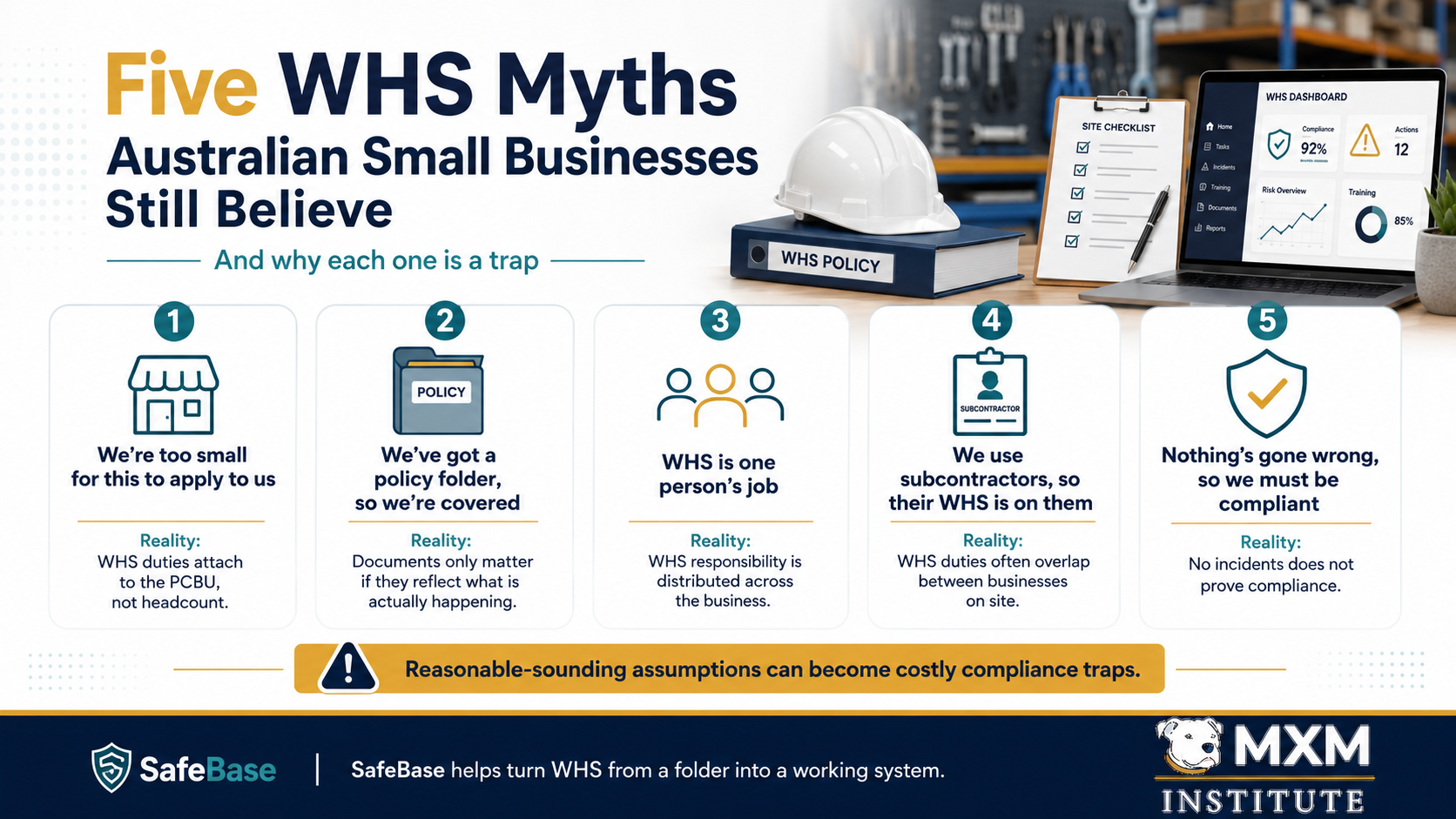
Most WHS compliance failures in small business don't come from owners who've decided the rules don't apply to them. They come from owners who believe something about WHS that sounds reasonable, has never been tested, and turns out to be wrong.
Here are five of the most common ones.
Myth 1: "We're too small for this to apply to us"
WHS duties attach to being a PCBU — a person conducting a business or undertaking — not to the number of people on the payroll. A sole trader with no employees still has duties: to themselves, and to anyone their work puts at risk, including subcontractors, clients, and members of the public who happen to be nearby. There is no small business carve-out in the legislation. What changes with size isn't whether the obligation exists, it's how formal the system needs to be to demonstrate it's being met.
Myth 2: "We've got a policy folder, so we're covered"
A written WHS policy is a starting point, not proof of compliance. If a regulator investigates after an incident, they're not primarily interested in what the document says — they're interested in whether it was actually being followed on the day. A risk assessment that was accurate two years ago and hasn't been looked at since isn't protecting anyone; it's just paper. The businesses that hold up under scrutiny are the ones where the paperwork reflects what's genuinely happening on site, kept current rather than filed and forgotten.
Myth 3: "WHS is one person's job"
It's common for a small business to appoint someone — a WHS officer, a site supervisor, whoever seems like the logical choice — and assume that appointment covers the business's obligations. It doesn't work that way. Under the model WHS laws, officers have a personal due diligence obligation to proactively ensure the business is managing its risks, separate from whatever any appointed WHS person is doing. The PCBU itself has consultation obligations to workers. And workers have their own duties to take reasonable care. WHS responsibility is distributed across the business, not delegated away by giving someone a title.
Myth 4: "We use subcontractors, so their WHS is on them"
Where a workplace involves more than one business — which is the norm on most construction and trade sites — WHS duties can overlap between them. Engaging a subcontractor to carry out work doesn't automatically transfer all responsibility for what happens on your site to that subcontractor. Depending on the circumstances, both businesses can hold duties toward the same workers and the same risks at the same time.
Myth 5: "Nothing's gone wrong, so we must be compliant"
This is the most persuasive myth, because it feels like evidence. But an incident-free track record isn't the same as an effective safety system — it can just as easily mean the gaps in your risk management haven't been exposed yet. Regulators, insurers, and (in situations of financial distress) administrators and liquidators don't assess compliance retrospectively based on luck. They assess it based on whether a reasonable system was actually in place, documented, and followed.
The pattern underneath all five
None of these myths come from bad intentions. They come from reasonable-sounding assumptions that were never actually checked against what the law requires or what's genuinely happening day to day. The businesses that get caught out are rarely the ones deliberately cutting corners — they're the ones who believed one of these and moved on.
Where MXM Institute fits in
This is exactly why a WHS system needs to be something a business actually uses, not a folder it files away — that's what SafeBase was built for. mxminstitute.com.au