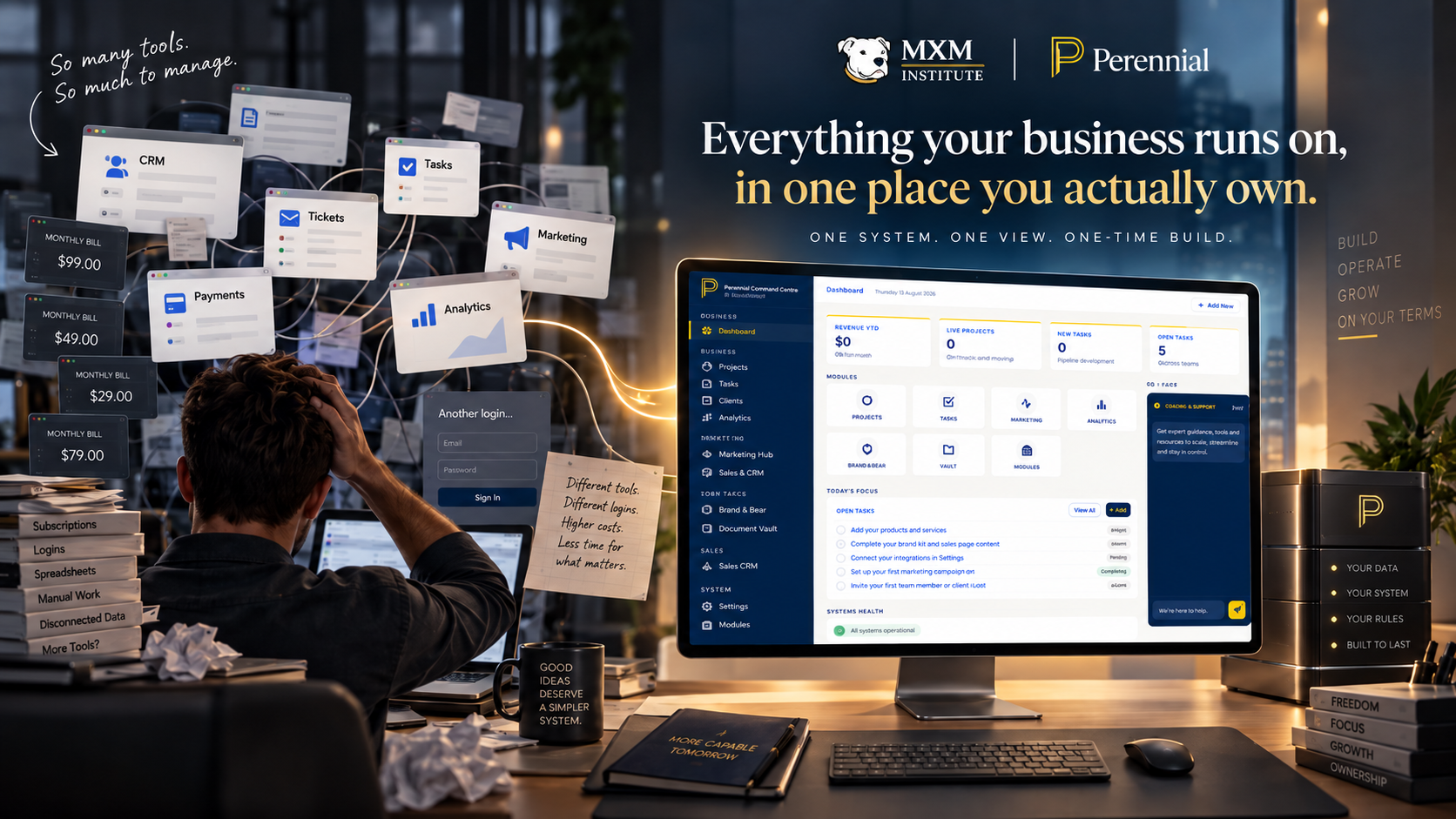
Most small businesses did not set out to run on five different tools. It usually happens one decision at a time. A CRM gets picked up to manage customers. A separate ticketing tool gets added when customer requests start slipping through the cracks. A task manager comes in because nothing else was tracking who owns what. Each choice made sense on its own. The result, a few years in, is a business running on a handful of subscriptions that were never built to talk to each other, each billed separately, every month, for as long as the business exists.
The real cost of a scattered toolkit
The cost is not just the sum of the monthly invoices, although that adds up faster than most business owners realise once it is actually totalled. The bigger cost is the time spent moving information between tools that do not share it automatically, and the blind spots that appear when no single place shows the full picture of what is actually going on in the business.
What one central command centre actually replaces
Perennial brings the tools a business actually uses day to day into one place. That includes practical, hands-on functions like a CRM for managing customers and a ticketing system for tracking requests, alongside task management and the other day to day operational work that currently lives scattered across separate logins. Instead of checking four different tools to understand where things stand, there is one place that already has the full picture.
Built around your business, not a fixed template
This is not a one-size-fits-all dashboard. Perennial is set up specifically for the business it is built for, with the tools and workflows that business actually needs. For a business that wants to start fresh, it can be built out from the ground up. For a business that already has systems it likes and does not want to abandon, Perennial can instead be programmed to work alongside or integrate with what is already in place, rather than forcing a full switch just to get everything into one view.
Where an integration connects to a third-party platform through that platform's own API, worth knowing upfront that some providers charge separately for that level of access. That cost, where it applies, is set by the third-party provider, not MXM Institute, and sits outside the one-time cost of building Perennial itself.
A one-time cost, not another subscription
Perhaps the most significant difference from the typical toolkit is how it is paid for. Perennial is a one-time cost, not another monthly subscription added to the pile. There is no ongoing licence fee from MXM Institute stacking on top of everything else a business already pays for, though where an integration depends on paid API access from a third-party provider, that specific cost sits with them, not with Perennial itself. The exact one-time cost varies with the size of the business and how it is set up, including whether it runs on the business's own local server or in the cloud, since a larger or more involved build naturally takes more to put together than a smaller one. What stays constant is the model itself: a one-time build, not an ongoing subscription. Compared honestly against several years of stacked subscriptions for separate tools that do not talk to each other, a single owned system tends to work out significantly cheaper, and leaves the business holding something it actually owns rather than access it loses the moment it stops paying.
Where MXM Institute fits in
Perennial brings a business's tools, including CRM and ticketing, into one central command centre, built around how that specific business runs and paid for once rather than billed monthly forever. mxminstitute.com.au