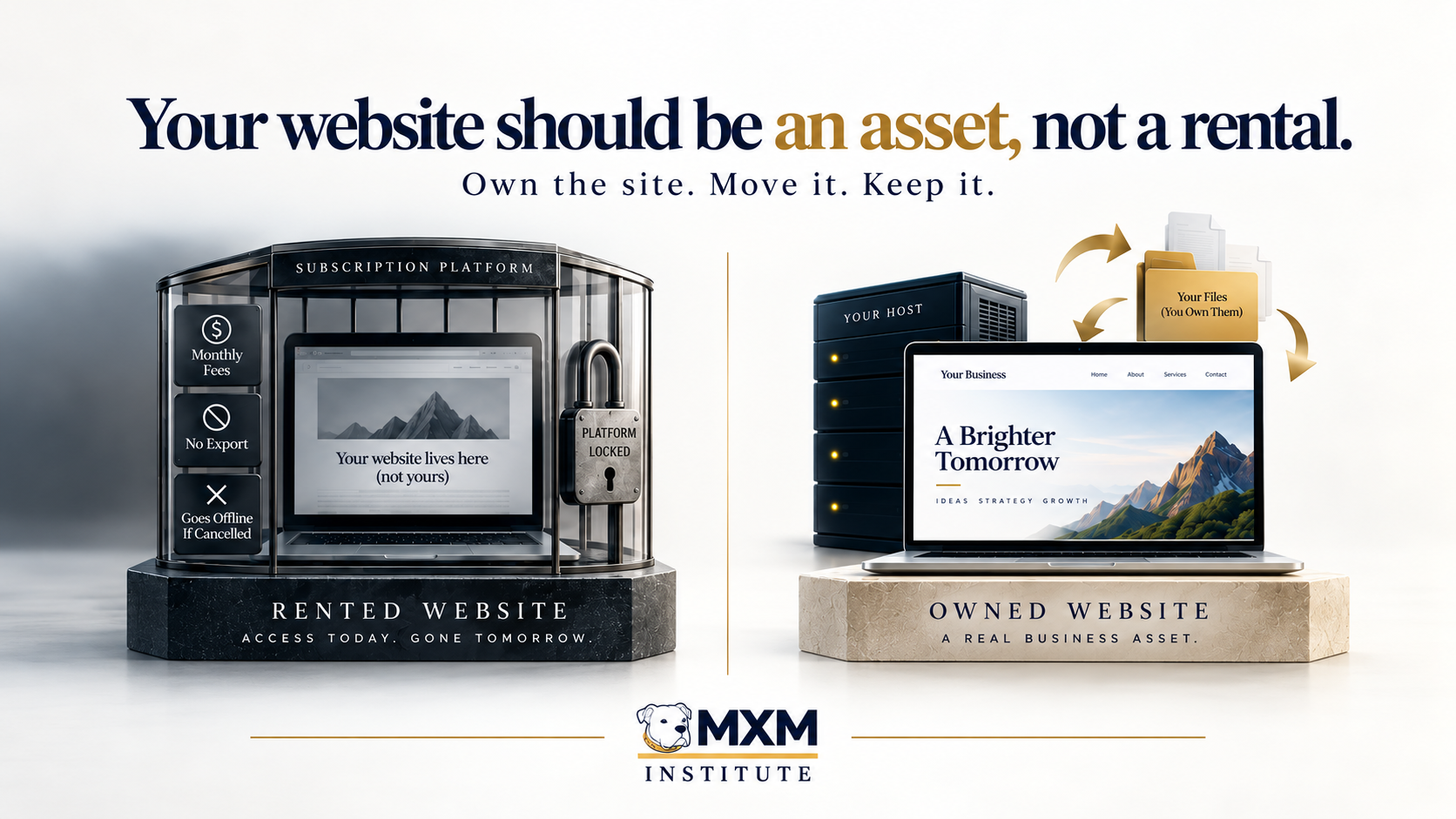
Ask most small business owners who owns their website, and they will say they do. Ask what happens if they want to leave their current platform and take the actual working site with them, and the answer changes fast.
Most all-in-one website builder platforms do not let you export a working copy of your site. The pages exist only inside that platform's own system, built with tools that only function there. Cancel the subscription, and the site typically goes offline within days. Even if you just want to move to a different host or developer while staying online, there is usually no way to take the actual working site with you, only fragments like the text content.
That is the part rarely spelled out at the point of sale. On platforms built this way, you are not buying a website. You are renting access to one, on their terms, for as long as you keep paying.
What a rented website actually looks like
A subscription-based website typically lives entirely inside one company's platform. The design, the hosting, and often the content itself are all tied to that one account. There is no separate copy of the finished site sitting anywhere you control. It exists on their terms, not yours, for as long as the relationship continues.
This is not a hidden scam. It is simply how a lot of all-in-one website builders are structured, and for some businesses that packaged convenience is genuinely useful. But it means the website itself is never really an asset on your side of the ledger. It is an ongoing expense with no residual value if it ever stops.
What owning a website actually means
A website built as a one-time asset is different in a specific, practical way. It exists as real files, built on standard web technology, sitting on standard hosting. There is no proprietary platform that has to keep running for your site to exist. If you want to move it to a different host, hand it to a different developer, or simply never pay anyone again, the site keeps working exactly as it did the day it was delivered.
That distinction matters most at the two moments business owners tend to overlook it: when a provider changes its pricing or shuts down, and when the business itself wants to switch who manages the site. Both situations are straightforward with an owned website. Both can be genuinely difficult, or impossible, with a rented one.
A one-time build costs more on day one. That is the wrong number to look at
An owned website usually has a higher upfront cost than the first month of a subscription platform. Compared honestly over two or three years, the maths tends to run the other way. A monthly fee that looks small in isolation adds up to a significant ongoing cost, and at the end of it, the business has nothing it can take with it if it ever stops paying. A one-time build costs more up front and leaves the business holding an actual asset indefinitely.
What to check before committing to any website provider
Whoever builds your next website, worth asking directly: can the finished site be exported and moved to a different host or developer if you ever want to? If the honest answer is no, you are renting, whatever the invoice calls it.
Where MXM Institute fits in
MXM Web Services builds websites as a one-time purchase, on standard hosting, with no ongoing platform dependency. Once it is built, it is yours, whether you ever come back to us for more work or not. mxminstitute.com.au